X̱aads Yahk'íi Haida Ways of Being: Acting with Yahgudang
Xaayda Gwaay.yaay ad Xaaydas Giinaa.ah Yahguudang dang.ad Kyaang.gaay ‘Laa Haida Gwaii and Haida Cultural Ways: with Respect and Take Care of
The Haida Laws Project began as a partnership between the Council of the Haida Nation and White Raven Law. In 2023, the Council of the Haida Nation (“CHN”) received a grant from the Law Foundation of British Columbia in the amount of $1.1 million to support the revitalization of Haida laws. In collaboration with its legal team at White Raven Law, the CHN is working with Haida leaders, knowledge-holders, community members, and youth to document and articulate Haida laws, or ‘ways of being’.
The Haida word for law, kil ‘yahda, means ‘saying it right, or with truth’. Haida law arises directly from Haida Gwaii and its Supernatural Beings and is intimately connected with the land and waters of Haida Gwaii. To engage in Haida ways of being, Haida citizens will join Elders and knowledge-holders in discussions about Haida protocols, values, stories, language, and culture on the lands and waters of Haida Gwaii, revitalizing and engaging Haida law. This project is unique in that it honours and make visible the Haida legal tradition and the Haida Supernatural worldview, and it employs methodologies rooted in Haida Gwaii.
White Raven’s legal team is also analyzing historical and ethnographic documents, oral recordings and testimony of Haida knowledge-holders, and contemporary governance documents, to synthesize Haida protocols as they have been expressed by the Haida for generations. The combined results will be brought to Haida communities for discussion and revision, resulting in a cohesive articulation of Haida law to serve as the foundation upon which CHN will build Haida legislation and judicial processes.
The Constitution of the Haida Nation was formally adopted in 2003 and mandates the CHN to “steward the lands and waters of Haida Territories on behalf of the Haida Nation, and to perpetuate Haida language and culture for future generations,” ensuring the Haida relationship with their ancestral territory continues in perpetuity. The formalization and implementation of Haida ways of being—grounded in the lands and waters of Haida Gwaii and expressed through the reciprocal relationships between the Haida and the Supernatural Beings—is one of the most important steps in fulfilling the mandate of the Haida Nation.
This Project is supported by a seed grant from the First Peoples’ Cultural Council, the Law Foundation of British Columbia, and the Vancouver Foundation.
Project Co-Directors
Gaagwiis Jason Alsop
Gid7ahl-Gudsllaay Lalaxaaygans Gaadaaldyas Terri-Lynn Williams-Davidson
Contact Information: haidalaws@whiteravenlaw.ca
Projects
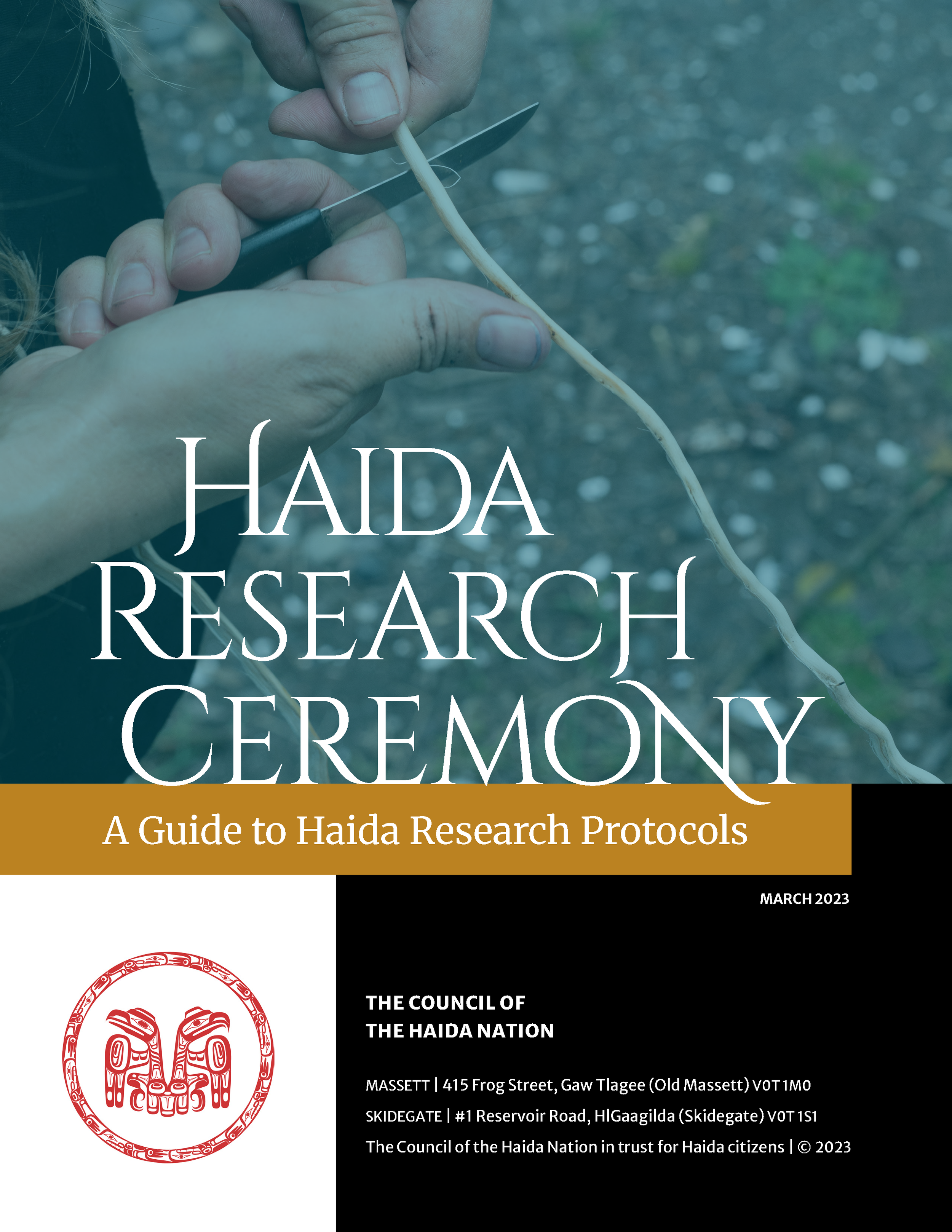
Haida Research Ceremony: A Guide to Haida Research Protocols – This was a First Peoples’ Cultural Council Braided Knowledge funded project to document research protocols that reflect Haida values, processes, and traditions and the “right ways” to do Haida research with respect. We were invited to attend an already planned (and self-funded) trip to gather Kayd hll.nga | hlíing (spruce roots) with three generations of master weavers: Ilskyalas Delores Churchill, Xiihliikingang April Churchill, and Jaad Tl’aaw Paula Varnell to Diinal Gandlaay (Gray Bay), Haida Gwaii in 2022. This report has been approved by the Advisory Council to release for public input.
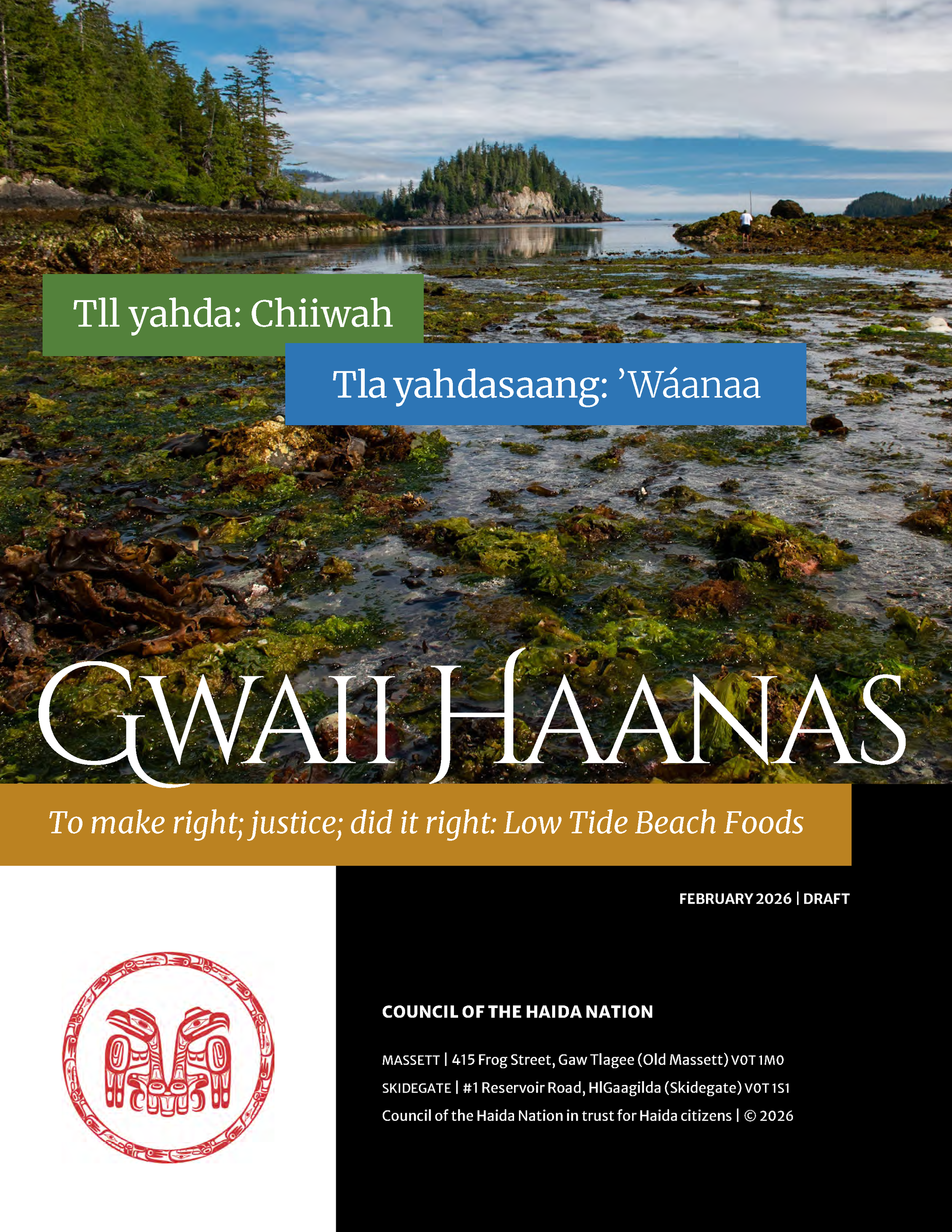
Tll yahda | Tla yahdagang: Gwaii Haanas Low Tide Beach Foods – The 2023 Gwaii Haanas trip focused on building relationships and understanding sustainable harvesting practices in the intertidal zone. Participants engaged in harvesting traditional foods like Hlk’wii | Hlk’wii (rock scallop). We were guided by GwaaGanad Diane Brown and GangXwad Larry Brown. The experience emphasized respectful boundaries regarding how much can be harvested and discussion of the preciarious state of certain seafood populations and the need for sustainable practices. The trip to Gwaii Haanas served as a foundational experience for the Haida Laws Project, emphasizing the importance of knowledge intergenerational knowledge transfer and community engagement.
This report has been approved by the Advisory Council to release for public input (See Full Report).
Kayd Hll.ngaay | Kíid Hlíing: Spruce Roots (Utilitarian Basket Weaving) – This report presents an exploration of Haida laws, traditions, and cultural practices, specifically focusing on the 2023 utilitarian basket weaving course centered around spruce root harvesting and weaving. Xiihliikingang April Churchill and Jaad Tl’aaw Paula Varnell invited our Project to document their knowledge. The course encompassed harvesting, processing, and weaving spruce roots, and this report documents the deep legal and cultural frameworks guiding these practices, and Haida laws as actively practiced today, connecting participants with ancestors and reinforcing Haida sovereignty and cultural continuity.
Jane Adams Kristovich Memorial – This report presents the Haida legal traditions, cultural protocols, and ways of being as enacted during the 2023 Celebration of Life of K’ujúuhl Jane Adams Kristovich in Seattle, Washington. K’ujúuhl was a first-language speaker of Xaad Kíl and contributed significantly to language revitalization efforts, including work on the Haida language film SGaawaay K’uuna: Edge of the Knife. We documented the feast, gift giving, and special payments to those who contributed to the event and language learners that worked closely with K’ujúuhl.
SGiidagiids, Naa ‘Yuuwns XaaydaGaay Pole Raising – In November 2023, we documented the pole-raising and Potlatch of the Naa ‘Yuuwans XaaydaGaay (Big House People). The pole, carved by Reg Davidson, was raised to honour the late Chief Skidegate Dempsey Collinson. At the Potlatch, the Chief of Naa ‘Yuuwans Sidney Crosby took a new name and became recognized as Chief SGiidagiids (Chief Skidegate). We also documented other clan business of cultural sharing, adoptions, and the sharing of Clan history that took place at this Potlatch.
Xaad Kil Language Conference – In January 2024, Xaad Kíl Née (XKN) hosted a Language Gathering at the Haida Heritage Centre in Kay ‘Llnagaay. As part of the Haida Language Gathering, XKN and the Haida Laws Project hosted a Naaw | Nuu (octopus) cooking demonstration led by chef Kil Tlatsgaa, Brodie Swanson. The goal was to empower Haida citizens to engage with Haida ways of being through the preparation of traditional foods. We documented the experience using audio recording and photography.
Halxa T’aa | Kaa T’aa: Chiton Harvest Report – In March 2024, Haida citizens were invited to Yaagan Kun|Yaagun Kun (Yakan Point) to learn the proper and respectful methods of harvesting t’aa (chitons) under the guidance of Xiihliikingang April Churchill and Kil Tlaa’sgaa Brodie Swanson. The event included harvesting, cleaning, cooking, and communal eating, emphasizing the importance of preserving traditional knowledge and laws concerning food harvesting. This report documents the cultural, legal, and ecological teachings conveyed in the harvest, emphasizing respect, intergenerational knowledge transfer, and the revitalization of Haida legal traditions related to harvesting beach foods.
Ts’uu | Ts’úu: Cedar Harvest – A cedar harvest event in June 2024, although interrupted by active logging, provided significant insights into Haida protocols and laws, especially through the teachings of Elder and Master Weaver Xiihliikingang April Churchill. This report provides an overview of the Haida Nation’s legal traditions, cultural values, and protocols centered around the cedar tree and forest ecosystems of Haida Gwaii, recognizing that the forest is home to not only humans, but to bears, birds, bugs, and generations of trees. The report explores asking permission first, careful and selective harvesting, how to handle the outer bark, and the mental and spiritual preparation needed to engage with cedar trees.
Other Projects
We partnered with the Haida Tidewalkers Program in 2025 to document traditional processing and fire-roasting of salmon.
DISCLAIMER | This summarizes the work of the Haida Laws Project and is intended as a high-level overview and does not reproduce the full scope of the draft reports. The draft reports should not be relied upon as a definitive statement of Haida law as further input and validation from Haida citizens, leaders, and knowledge holders are required before any final conclusions can be drawn.
Reports